Antique Bible 1528 Estienne First Edition, Vulgate, Hand-Coloured
Antique Bible 1528 Estienne First Edition, Vulgate, Hand-Coloured
Couldn't load pickup availability
Biblia. Paris: Ex officina Roberti Stephani, 1528, folio.
THE COLBERT-DE-PRADEL COPY OF THE FIRST ESTIENNE BIBLE, THE MOST ELEGANT POST-INCUNABLE BIBLE, AND THE EDITION THAT LAUNCHED ROBERT ESTIENNE'S CELEBRATED CAREER.
-------------------
FIRST EDITION of the monumental Latin Bible of Robert Estienne, his first major work and the publication that established him as the leading figure in the Parisian book trade. The work is “considered the earliest genuine attempt at a critical edition of the Vulgate text… [and] became practically the foundation of the official Roman Vulgate” (Schreiber).
Published after nearly a decade of scholarly labour, the edition is based on the collation of the oldest manuscripts available in the Royal Library and the principal Parisian abbeys, alongside earlier printed editions and the Complutensian Polyglot Bible. Estienne introduced a series of decisive editorial innovations: chapter summaries, concordances, and extensive marginal variants, as well as the systematic restoration of proper names in their Hebrew, Chaldean, Greek, and Latin forms. Particularly notable is the vast Index nominum, designed to stabilise biblical nomenclature. This edition foreshadows the numbered verse divisions with chapter numbering which Estienne would later formalise in his 1555 Bible and subsequently standardised in Protestant tradition, notably in the 1560 Geneva Bible.
The work is equally a typographical landmark. Printed in two columns, it presents for the first time Estienne’s celebrated olive-tree device, woodcut and signed with the Cross of Lorraine, nearly full-page on the title, this copy finely hand-coloured. It also marks the first use of Geoffroy Tory’s elegant criblé initials in two sizes, among the most refined decorative initials of the French Renaissance. The extraordinary care devoted to both text and design immediately secured Estienne’s reputation as the foremost printer-scholar of his generation.
VERY RARE. USTC records just 11 copies held institutionally worldwide (two in the US) and we can trace just three other copies to have appeared for sale in recent decades, none with such a fresh and elegant interior or as distinguished a provenance as this copy.
-------------------
Provenance:
1. Early ecclesiastical ownership (plausibly very early Jesuit), 16th-17th century. The hand-coloured title woodcut has some beautiful contemporary or near-contemporary hand-colouring with a Sacred Heart within a green laurel wreath, an emblem suggestive of the Society of Jesus (Jesuits), founded in 1540.
2. Charles de Pradel (c.1644-1696), Bishop of Montpellier. De Pradel maintained a notable episcopal library at Montpellier; this volume was likely part of that collection.
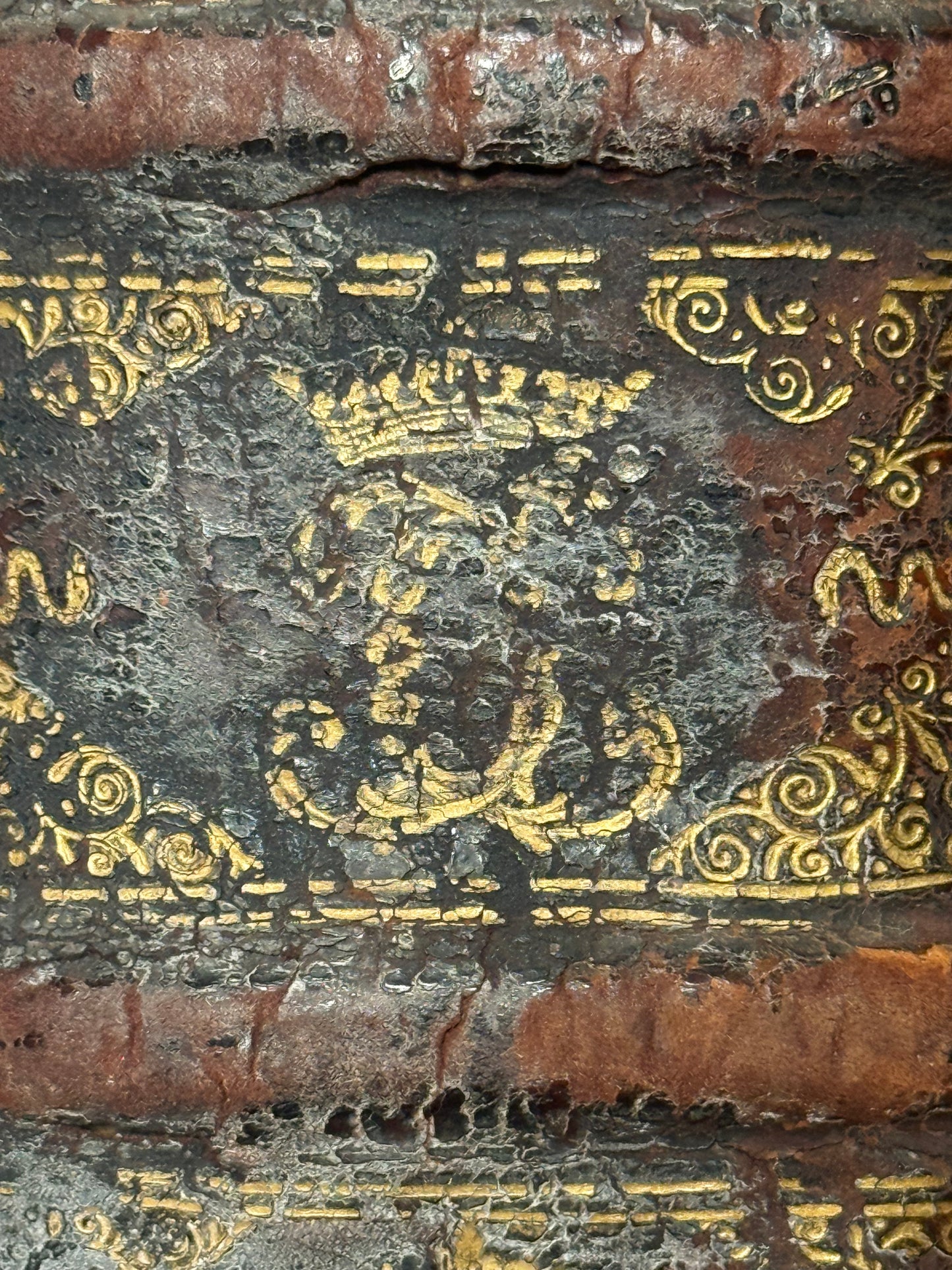
3. Jacques-Nicolas Colbert (1655-1707), Archbishop of Rouen. Bound in 17th century calf with his gilt arms to both boards and his crowned double-C monogram repeated in the spine compartments. Son of Jean-Baptiste Colbert, minister to Louis XIV, Jacques-Nicolas Colbert was a prominent scholar and bibliophile whose library at Rouen is recorded in O.H.R. 1298. The familial link between the Colbert and de Pradel circles, his cousin Charles-Joachim Colbert de Croissy succeeding de Pradel at Montpellier, provides a clear and compelling transmission between these two owners.
4. Later private French ownership, by descent, until recently.
-------------------
Size: 269 x 380 mm (approx.)
Condition:
[(1), *¹⁰, a–z⁸, A–P⁸, Q–R⁶, S–Z⁸, Aa–Cc⁸, Dd⁶; aa–dd⁸, ee¹⁰, aaa–fff⁸, (1)]
Collates as complete including all preliminaries. The title woodcut is finely hand-coloured in a near-contemporary hand with a Sacred Heart enclosed in a green laurel at the foot, an emblem suggestive of very early Jesuit ecclesiastical ownership (the Society of Jesus having been founded in 1540). Although the title leaf is now detached, it can be confidently assigned to originally belong to this copy on the basis of consistent provenance, particularly the clear relationship between the inscription adjacent to the date and the binding as discussed above.
Typographically, this is among the most elegant editions we have encountered: a magnificently printed Bible, distinguished by clarity of impression and refinement of design. The text block is exceptionally clean and bright throughout, with each leaf fully red-ruled in a notably restrained and tasteful manner. This ruling, along with the red-coloured edges, appears to post-date publication by approximately half a century (c.1580? seemingly after the title was coloured). The edition itself is among the finest printed Bibles of the post-incunable period, with thousands of engraved initials and generously proportioned margins.
The condition of the text is very good indeed. There is occasional light spotting and the odd minor stain, typically the result of the red-ruling process or small ink marks, but nothing of real consequence, with the entire text fully legible without loss of sense throughout. A few small drops of candle wax are visible in the upper blank margins of Dd1-3, not affecting the text. There is also a faint and localised dampstain to the lower blank margins of gatherings aa–cc in the second work (not affecting the Bible proper), and sporadically within the final index, again without impact on the text.
There is some very occasional contemporary marginalia in a neat hand (e.g. p1), along with instances of neat contemporary rubrication in black (e.g. D8). A contemporary ex libris inscription appears on the privilege leaf at the rear; it is now largely effaced and illegible, though potentially recoverable under careful examination.
Bound in a 17th-century full calf binding, rubbed and discoloured, with some losses to the leather and wear to the gilt. The central arms, now worn, are those of the Colbert family, certainly attributable to Jacques-Nicolas Colbert, whose crowned crest is repeated in the spine compartments. Red morocco label present. Joints are rubbed, worn, and cracked, but both boards remain attached, albeit somewhat fragile. No bookplates. Preliminary blank and title leaf detached, but present.
An attractive copy, particularly internally, of one of the most important and aesthetically refined Bibles of the sixteenth century.
[USTC 181095; Moureau III, 1373; Pettegree 57301; Darlow & Moule 6109; Schreiber 37].