Biblia, thet är: All then Helga Skrifft på Swensko. Uppsala: Jürgen Richolff, 1540-1541, folio.
The Gustav Vasa Bible – the first complete Bible printed in Swedish, the cornerstone of the Swedish Reformation, and a typographical masterpiece of the Northern Renaissance.
-------------------
The Gustav Vasa Bible is among the most important printed books in Scandinavian history. Commissioned by King Gustav I Vasa and published in Uppsala in 1540-1541, it is the first complete Bible in the Swedish language and the most ambitious typographical undertaking ever attempted in Sweden.
Following the Reformation and Sweden’s decisive break with Rome, Gustav Vasa sought to establish a national Church under royal authority, independent of papal control, his policy and the timeline thereof closely paralleling that of King Henry VIII in England. Central to this programme was a vernacular Bible to replace the Latin Vulgate. However, the Swedish clergy’s limited knowledge of Hebrew and Greek made direct translation from the originals impossible, and so the translators relied heavily on Martin Luther’s German Bible of 1534, adapting both its text and its theological spirit to Swedish use.
The project was overseen by Archbishop Laurentius Petri, head of the royal Bible Commission, with significant participation by his brother Olaus Petri and other reformers. Laurentius Petri wrote in 1540 that he was “along with others busy with the work,” a modest reflection of the monumental scale of the task. The Old Testament was based largely on Martin Luther’s 1534 translation, while the New Testament revised the earlier Swedish version of 1526. Of note is the almost identical timeline with the 1526 first English edition of the New Testament and the 1535 first complete edition of the English Bible.
The resulting language of the Gustav Vasa Bible exerted a profound and lasting influence on Swedish identity. The Vasa Bible has rightly been called “the birth certificate of the Swedish language.” Its dignified prose established norms of orthography and syntax that shaped Swedish writing well into the nineteenth century. Indeed, the translation remained the basis for all subsequent Swedish Bibles well into the nineteenth century. Few printed works have had such an extraordinary impact on the development of a European vernacular.
The illustrations are of note, with the printer importing an extensive suite of woodblocks from Wittenberg, among which include seven original woodcuts by Lucas Cranach the Elder and three by Georg Lemberger. However, the greatest significance lies in the world map which is often missing, but a lovely example is present in our copy. This was the first printed map in Sweden.
EXTREMELY RARE. The Gustav Vasa Bible was issued in limited numbers for official church use, and after nearly five centuries of constant ecclesiastical service, very few copies survive, especially in private hands. Complete examples are essentially unobtainable. USTC records just ten copies held institutionally worldwide, with NO COPIES RECORDED IN NORTH AMERICA, and just five outside of Scandinavia (three in the UK, all at the British Library, and two in Germany). We trace no complete copies in commerce.
-------------------
Size: 201 x 305 mm (approx.)
Condition:
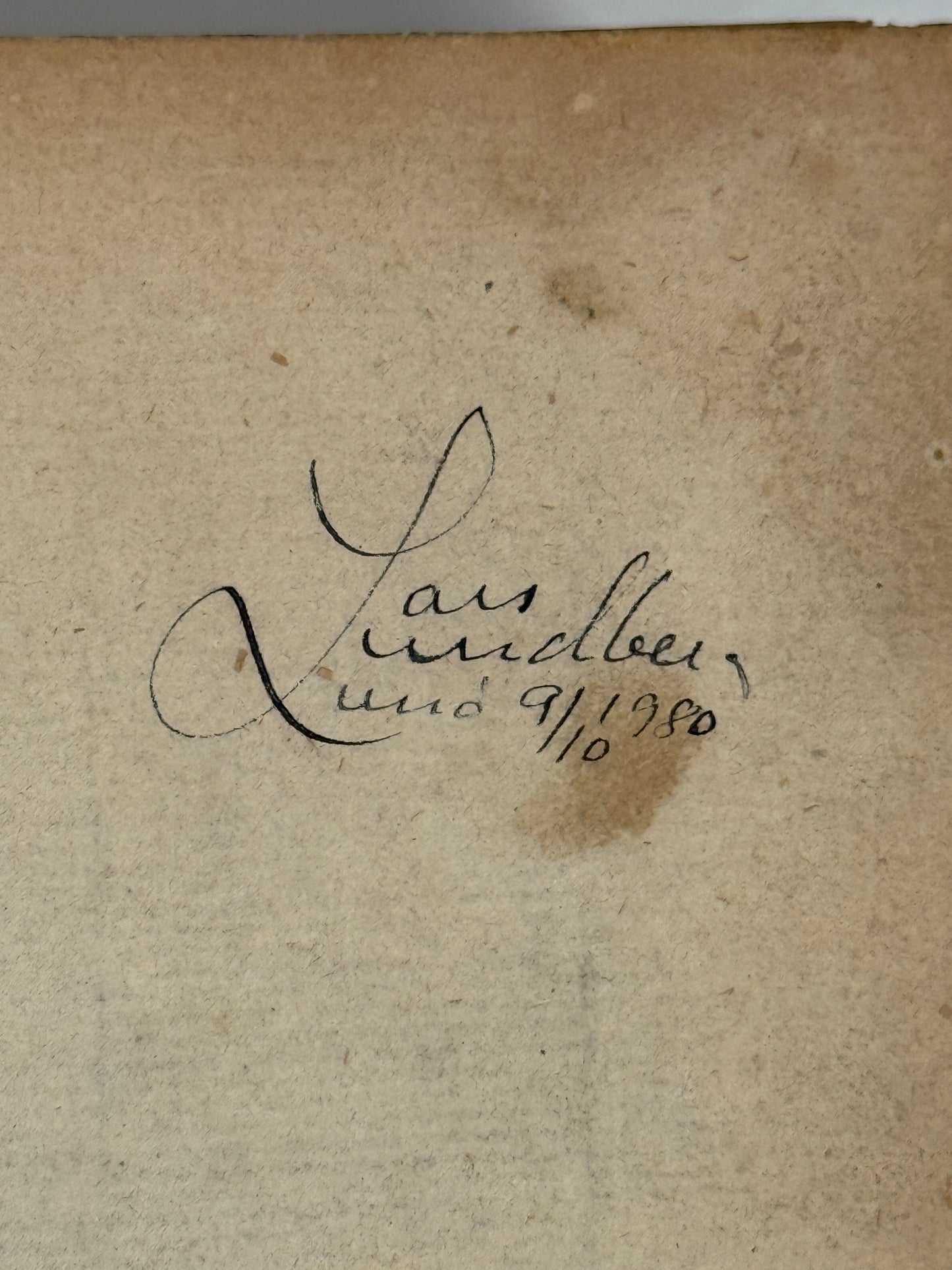
Circa 20th century full calf, "Bibeln" tooled in gilt to spine with the date and place of printing at the foot, spine with raised bands. Both boards securely attached, binding secure, scuffed with some shelf and edge wear, small hole to front board where one joint is. Small stain to top leaf edges else very good. Bookplate to front pastedown with a corresponding small neat ownership inscription to head of ffep recto dated 1980.
730 leaves (of 762), lacking the general and New Testament title leaves, as often, as well as thirty textual leaves throughout, also as often. The important world map leaf is present. Though plate counts vary in recorded copies, it seems that 60 woodcuts are called for. Our copy contains 43 woodcuts, 10 of which are large full leaf size. Many leaves misbound in order, particularly in the first few quires, with some leaves which might at first appear to be lacking later appearing in other quires, often in a manner which is difficult to notice as some are without the printed signatures (as printed). Georg Lemberg's famous full leaf woodcut for Job is present (verso of a divisional title leaf). The divisional blank for the NT is present. Hundreds or possibly thousands of (printed) decorated initials/capitals throughout, many of which are historiated.
Some leaves with losses at edges, these having been repaired, in all instances, with blank paper, occasionally catching MS or printed marginalia, the occasional headline, signature, etc, and, in a smaller number of cases, a bit of text or some of an illustration; these issues generally being found at each end of the text (i.e. in the Pentateuch and the end of the NT), but also sporadically throughout. Generally nice and clean throughout, mildly toned, sporadic foxing, some very light faded dampstaining to a few quires. Contemporary neat marginalia throughout, also marginalia in a few later hands, all in Swedish, seemingly none later than circa the 18th century. The contemporary marginalia seems to be largely concentrated in the Psalms, but is found throughout more sporadically.
[USTC 300265; OCLC 225822272; Collijn, Sveriges bibliography intille ar 1600, vol. 2, pp.88-104].
*The National Library of Sweden's copy, via WorldCat, describes this as "the largest printed work produced in Sweden during the 16th century."